Last updated October 15, 2026
ADU Cost Breakdown: The Dallas Homeowner’s Reference for 2026
When a Dallas ADU quote comes in $60,000 below the next bid, it usually means one of four things: the scope is narrower, the finishes are cheaper, the permit is missing, or the contractor plans to find the money somewhere in change orders. That spread is not a market. It is a failure of apples-to-apples comparison. This guide names the actual cost categories, puts current Dallas labor and material rates against them, and shows where the variance lives. For a deeper look at the full process, see our Complete Guide to ADU in Dallas. You will leave knowing how to read a bid, what a complete scope looks like in writing, and which numbers to believe when a contractor hands you a price for an ADU in Dallas.
Quick Answer
Most ADUs in Dallas cost between $95,000 and $275,000 in 2026, with detached new builds running $190 – $320 per square foot, garage conversions at $80 – $150 per square foot, and above-garage additions at $220 – $380 per square foot. A complete written quote should break down into five fixed categories: design and engineering, permit fees, site prep, construction, and utility connections. The single best protection against a moving price is a written fixed-price contract that lists the full scope before any work begins.
Table of Contents
- What the Dallas ADU Market Actually Looks Like in 2026
- Cost Per Square Foot by Construction Type
- The Fixed Costs Every ADU Carries, Regardless of Size
- Where the Real Variance Lives: Foundation, HVAC, Cladding, Finishes
- What a Written Fixed-Price Contract Protects Against, in Dollars
- How to Read a Bid: Complete Scope or Placeholder
- Common Mistakes to Avoid
- When to Call a Professional
- Frequently Asked Questions
- The Bottom Line
What the Dallas ADU Market Actually Looks Like in 2026
Dallas has been late to the ADU conversation compared to Austin or Portland, but the last three years changed that. The 2023 zoning revisions made detached accessory dwelling units legal on a meaningful share of single-family lots across the city, and demand followed fast. If you’re seeing red flags in contractor bids, our ADU Warning Signs: A Dallas Homeowner’s Reference Guide can help. We now see ADU inquiries from homeowners in Lakewood, East Dallas, Casa View, and Oak Cliff with the same frequency we used to see only garage conversion calls. The market is newer here, which means the range of prices is wider. Contractors who have built fifty ADUs in California have a tight per-square-foot number. Contractors in Dallas who have built three are still guessing, and the guesses show up as bids that are $40,000 apart for the same square footage.
Labor costs in Dallas have shifted, too. Electricians and plumbers who were doing commercial work during the 2023 – 2024 construction pullback have moved back to residential, and their rates now reflect the competition. A journeyman electrician in Dallas bills at $95 – $140 per hour in 2026, depending on whether the shop is doing service calls or bid work. Framing labor for a small detached structure runs $8 – $14 per square foot. These are not hidden numbers. They are knowable, and a contractor who prices by them will produce a predictable bid.
What we see in our own work at Fielding ADU Dallas home is a market where homeowners are better informed than they were two years ago. They have read about Abodu and Boxabl and Plant Prefab. They know prefab exists. They want a straight answer about whether it saves money. The answer is sometimes, and only when the site work is simple. More on that in the construction type section below.
Cost Per Square Foot by Construction Type
The first division that matters is not size. It is how the structure meets the ground and how much of it already exists. Three construction types dominate Dallas ADU work in 2026: detached new builds, garage conversions, and above-garage additions. Each has its own per-square-foot range, and each carries different fixed costs.
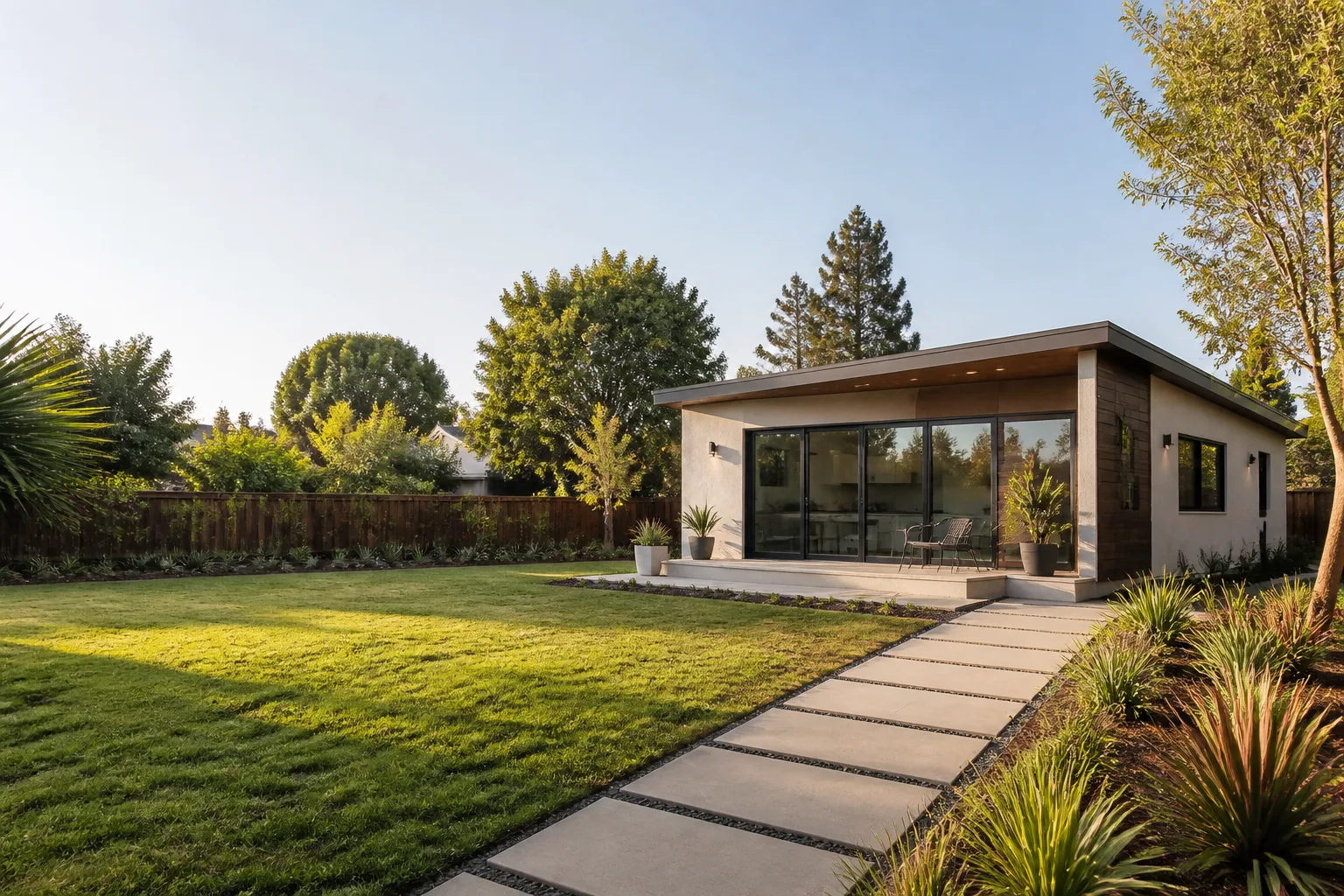
Detached new build: $190 – $320 per square foot. A 600-square-foot one-bedroom detached ADU in Dallas lands between $115,000 and $195,000 at this range. The spread comes from foundation type, cladding, HVAC, and finish level. A new structure needs everything: excavation, concrete, framing, roofing, electrical service, plumbing from the main line, drywall, paint, fixtures. Nothing is already there. That is why this is the most expensive type, and also the most predictable, because there is no hidden condition inside an existing wall.
Garage conversion: $80 – $150 per square foot. A standard two-car garage in Dallas contains roughly 400 square feet. Converting it runs $32,000 to $60,000, before permit fees and depending on how much of the existing structure is usable. The roof and walls are already standing, which saves real money. What eats into the savings: the slab may need to be cut for plumbing, the garage door opening must be filled and reframed, and the electrical panel may be undersized for a dwelling unit. These are known conditions with known fixes. A good bid will list each one as a line item.
Above-garage addition: $220 – $380 per square foot. This is the most expensive option per square foot because it involves structural reinforcement of the garage below, stairs, and more complex framing and waterproofing. A 500-square-foot above-garage ADU in Dallas typically lands between $110,000 and $190,000. It is the right choice for lots with no yard space, but it is not a budget option.
The prefab question deserves a straight answer. Panelized and modular systems like Abodu and Plant Prefab can produce a detached ADU with less on-site framing time, and under the right conditions the all-in number lands in the $250 – $320 per square foot range. When the lot is flat, access is open, and the city’s plan check does not drag on, prefab can beat site-built by 10 – 15%. When the lot is sloped, access is tight, or the zoning requires a custom setback, prefab starts losing its advantage fast. We have built with several of these platforms. They are not a gimmick. They are a tool, and the right tool depends on the lot. If you are weighing options, our page on ADU Builders in Dallas lays out how we match the build method to your budget and site.
The Fixed Costs Every ADU Carries, Regardless of Size
There is a floor under every ADU budget that does not care whether you are building 400 square feet or 900. These fixed costs are the reason a tiny ADU never costs $40,000, and why bids that promise that number are not complete bids.
- Design and engineering: $6,000 – $18,000. A detached ADU needs architectural drawings and a structural engineer’s stamp. Garage conversions need less design work but often more engineering, because the existing slab and roof were not built as living space. Expect the lower end for simple conversions and the upper end for two-story or custom detached structures.
- Permit fees: $2,500 – $9,000 in Dallas. The City of Dallas permit fee schedule is public. Fees are calculated from the project valuation, plus plan review, plus impact fees. An ADU is not a shed. It is a dwelling unit, and the city reviews it as one. Schools and park impact fees apply in some areas. Your contractor should list permit fees as a separate line, not bury them in “miscellaneous.”
- Utility connections: $4,000 – $15,000. A detached ADU needs water supply, sewer or a separate septic connection, and a new electrical service or a subpanel run from the main. In many Dallas neighborhoods, the sewer line is clay and old, and tying into it costs more than the homeowner expects. Trenching across a 60-foot yard is a real cost. It shows up in every honest bid.
- Site prep: $3,000 – $20,000. Clearance, grading, demolition of an existing slab or structure, tree removal, and temporary access. Flat lots with no trees and a clear path for equipment land on the low end. A lot with a mature pecan tree, a retaining wall, and a sloping grade lands on the high end. This is the line item most likely to be understated in a bid designed to look competitive.
- Contractor overhead and profit: typically 15 – 20% of direct costs. This is not a fee. It is a fact. A business that does not charge overhead cannot stay in business, which means it stops answering the phone when problems arise. If the number is 8%, the contractor is either desperate or hiding the real margin elsewhere.
These five categories together account for $20,000 to $50,000 of every ADU project in Dallas, before the first wall goes up. A bid that does not show them as separate lines is a bid that has not actually estimated the project. It has guessed, and you will pay for the guess.
Where the Real Variance Lives: Foundation, HVAC, Cladding, Finishes
Once the fixed costs are set, the rest of the spread between a $120,000 ADU and a $220,000 ADU of the same square footage comes down to four decisions. Each has a range. Each is a choice you make, not a mystery the contractor controls.
Foundation type
- Slab on grade: $8 – $14 per square foot. Standard for flat Dallas lots. Fast, predictable, and adequate for most ADUs.
- Pier and beam: $15 – $25 per square foot. Needed when the lot slopes, when the soil has drainage issues, or when the ADU is attached to an older pier-and-beam house and the floors must match.
- Raised foundation with crawlspace: $20 – $35 per square foot. Rarely chosen for ADUs, but occasionally required by floodplain regulations in parts of East and South Dallas near the Trinity River.
HVAC system selection
- Ductless mini-split, single zone: $3,500 – $6,500 installed. The right answer for most ADUs under 700 square feet. Efficient, quiet, no ductwork.
- Ducted central system: $8,000 – $14,000 installed. Usually unnecessary in an ADU, but sometimes requested by homeowners who want ceiling registers and uniform airflow.
- Window units or baseboard heat: not legal as primary heating in a permitted ADU in Dallas. Anyone suggesting this is not pulling a permit.
Exterior cladding
HardiePlank lap siding from James Hardie runs $4 – $7 per square foot installed in Dallas and holds paint better than wood in our summer heat and the hail cycles that come through every few springs. Vinyl is cheaper upfront, at $3 – $5 per square foot installed, and it is a legitimate choice for a rental ADU. Stucco and brick are the top end, and brick in particular is rare for ADUs because matching the main house’s brick is difficult and expensive. We specify James Hardie on most of our conventional builds because it handles the Dallas climate well and it looks like it belongs on a house, not a shed.
Finish level
- Rental-ready: laminate counters, stock cabinets, vinyl plank flooring, standard fixtures. $18 – $28 per square foot of interior.
- Mid-grade: quartz counters, semi-custom cabinets, tile shower, upgraded LVP or engineered hardwood. $28 – $45 per square foot.
- High-end: custom cabinets, stone counters, hardwood, designer fixtures, upgraded doors and trim. $45 – $70 per square foot.
Add these four categories together and you can move a 600-square-foot ADU from $120,000 to $210,000 without changing the footprint. The variance is real, but it is also visible. A contractor who asks you to choose a foundation type, an HVAC approach, a cladding material, and a finish level before pricing is doing the job honestly. A contractor who hands you a single number with no such conversation is not pricing your project. They are pricing a version of it that exists in their head.
What a Written Fixed-Price Contract Protects Against, in Dollars
The difference between a fixed-price contract and a time-and-materials contract is not legal fine print. It is the difference between a project that ends at the number you approved and a project that ends whenever the contractor stops finding reasons to keep billing.
A time-and-materials ADU in Dallas carries a structural risk: every hour the contractor’s framing crew does not finish is an hour you pay again. Every trip to the lumber yard is another load fee. Every change to the electrical plan is another service call. On a project that runs four to seven months, the accumulated overages on a time-and-materials contract routinely reach 20 – 35% of the original estimate. On a $150,000 ADU, that is $30,000 to $52,500 you did not approve in writing. A written fixed-price contract does not make surprises impossible; no contract can. But it transfers the risk of estimating error from you to the contractor, which is where the risk belongs, because the contractor is the party who knows what the work actually costs.
This is the operating principle behind The Garrison Code, the standard Fielding ADU Dallas holds itself to as part of the Garrison Partners family, which has been building to this standard since 2006. The code is simple: show up in the window, price in writing, build by the book, leave it clean, stand behind it for a year. The written price comes before any work starts. The number you approve on day one is the number on the final invoice. If something about the scope changes along the way, the change is priced in writing and approved by you before the work proceeds. That is not a sales pitch. It is the only way we would run the business, because it is the only way a homeowner can actually plan their money.
Watch for the phrase “estimate” on a bid. An estimate is an opinion. A fixed-price contract is a commitment. We write contracts.
How to Read a Bid: Complete Scope or Placeholder
You cannot tell if a number is good until you know what it covers. The same $140,000 can be a complete ADU with drywall, paint, HVAC, and a certificate of occupancy, or a shell with open studs and a promise that finishes will be “priced later.” Reading a bid is a skill, and it takes ten minutes to learn.
- Look for the five fixed categories by name. Design, permits, site prep, utilities, and construction should each appear as a line or a clearly labeled section. If any of them is missing, the number is not real.
- Check the allowances. A bid with “cabinet allowance: $800” is pricing cabinets that cost $2,400. That is a placeholder designed to make the bottom line smaller. Allowances should match actual Dallas retail prices for the finish level you discussed.
- Look for the phrase “as per plan” or “per owner selection” without a corresponding spec. If the bid says “flooring per owner selection, allowance $1,500,” and you know the ADU is 600 square feet, the allowance covers $2.50 per square foot. That buys sheet vinyl. If you discussed hardwood, the bid is not honest.
- Check for a permit line that says “by owner.” That means you are the contractor of record for permitting. If the work does not pass inspection, the liability is on your name, not the builder’s. A licensed contractor should pull the permit. If a bid pushes permitting onto you, ask why.
- Search for the words “estimate” versus “contract.” An estimate can move. A written fixed-price contract does not. If the document you are asked to sign says “estimate” anywhere in the header, you are not signing a contract. You are signing an intention.
- Confirm the finish list is attached. A complete bid includes a finish schedule: specific flooring product, cabinet line, countertop material, fixture brand, paint grade, door style. If it is not attached, the contractor has not actually priced the job.
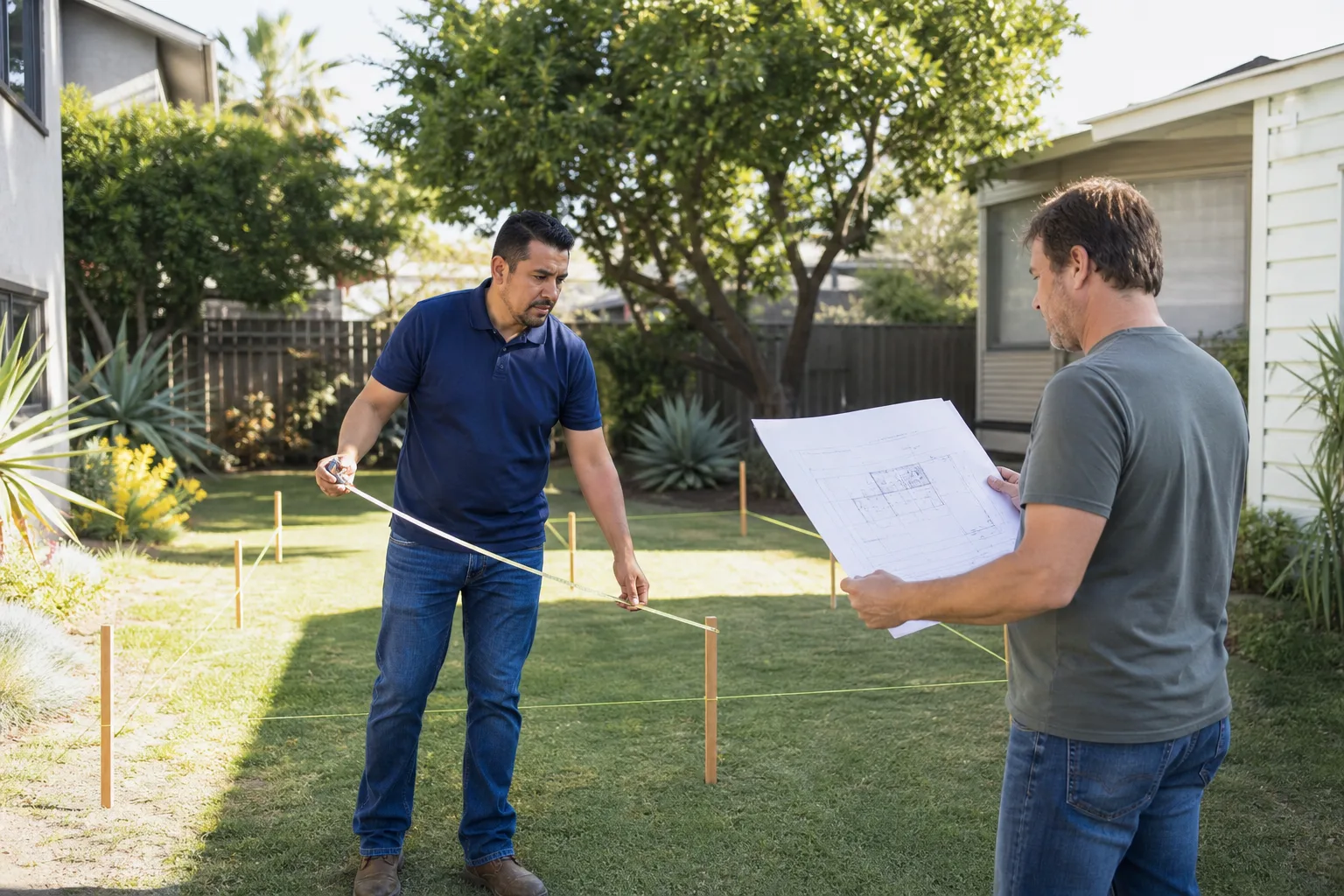
In our experience in Dallas, the bids that need the most scrutiny are the ones that arrive fastest. A contractor who can price a complete ADU in two days is either pricing a previous project that looked like yours, or they are leaving things out. A thorough bid takes time because measuring, checking the panel, walking the sewer line, and calling the city about zoning all take time. A bid that took three weeks and still has missing categories is worse than no bid at all. Take it apart. The bid is not just a number. It is the contractor’s plan for your money.
Common Mistakes to Avoid
- Signing a bid that says “estimate” at the top. An estimate is an opinion, not a commitment. If the number moves later and the document said estimate, you have little to stand on. A fixed-price contract with a written scope is what protects you.
- Comparing bids by bottom line only. A $25,000 spread is often not a price difference. It is a scope difference. Pull each bid apart line by line before you decide which number is real.
- Assuming the permit is included when the line is blank. If there is no permit line, the permit is not included. On a Dallas ADU, that is $2,500 – $9,000 you will find out about later.
- Underestimating site prep. The most common source of surprise overages in Dallas is the ground itself: old clay sewer lines, tree roots, sloped lots, and retaining walls. A good contractor walks the site before pricing. A great one brings a level and a probe.
- Choosing an HVAC system that does not match the space. A ducted central system in a 500-square-foot ADU costs more than it should and delivers worse comfort than a mini-split. The right system is a decision, not a default.
- Not asking how changes are priced. Every project changes a little. If your contractor does not have a written change order process, every change is a blank check. Ask before you sign, not after.
- Hiring a contractor who will not give you a written guarantee. The Garrison Standard exists because most contractors will not put their workmanship warranty on paper. If a builder balks at a written one-year guarantee, that tells you what their own confidence level is.
When to Call a Professional
The moment to call a professional is before you buy land, before you sign anything, and before you spend money on design drawings. If you are looking at a property in Dallas and wondering whether an ADU will fit, call us. If a contractor handed you a bid and something about it does not sit right, call us. If you have three bids that are $60,000 apart and you want to know which one is real, call us. Fielding ADU Dallas offers free estimates in Dallas, and we will walk your lot, check the zoning, and tell you what the project actually costs, in writing, before any work starts. We are the Room Addition Contractor in Dallas that writes the price down first. Call (903) 342-8977 and we will put it on paper.
Frequently Asked Questions
Most ADUs in Dallas cost between $95,000 and $275,000 all-in, with the average falling around $150,000 to $190,000 for a 600 – 800 square foot detached unit. Garage conversions run $32,000 – $60,000 plus permits, and above-garage additions run $110,000 – $190,000. The exact number depends on foundation type, HVAC selection, cladding, and finish level, not just square footage.
Yes. An ADU is a dwelling unit, and the City of Dallas reviews it as one. Permit fees run $2,500 – $9,000 depending on project valuation and impact fees. A contractor who suggests skipping the permit is asking you to carry risk that no insurance policy will cover. The right answer is always to pull the permit, build by the book, and pass the inspection.
On a time-and-materials contract, yes, and frequently. On a written fixed-price contract, no, unless you approve a written change order for a scope change you requested. The difference matters: a fixed-price contract puts the estimating risk on the contractor, where it belongs. Fielding ADU Dallas writes the price before any work starts, and the number you approve on day one is the number on the final invoice.
Yes, usually by 30 – 50% per square foot, because the roof, walls, and slab already exist. But the slab may need cutting for plumbing, the garage door opening must be reframed, and the electrical panel may need upgrading. Those are known conditions that a good contractor identifies in the bid. A standard 400-square-foot garage conversion in Dallas runs $32,000 – $60,000 before permits.
Sometimes. Panelized and modular systems like Abodu and Plant Prefab can land 10 – 15% below site-built when the lot is flat, access is open, and the plan check moves cleanly. On sloped lots, tight access, or custom zoning conditions, prefab loses much of its advantage. The right method depends on your specific site, not on a brochure.
A detached ADU typically takes 4 – 7 months from permit submission to final inspection. Garage conversions usually run 2 – 4 months. The biggest schedule variables in Dallas are city plan check turnaround and weather windows for foundation and framing work. A written schedule with milestone dates should be part of your contract, just like the written price.
The Bottom Line
An ADU in Dallas costs between $95,000 and $275,000 in 2026, and the spread is not a mystery. It is the sum of foundation type, HVAC system, cladding, finishes, and the five fixed categories every project carries. When a bid comes in far below the rest, it is missing something: scope, finishes, permit, or margin. The fix is a written fixed-price contract that lists every category, every allowance at real Dallas prices, and every finish product by name. The Garrison Code is our answer to a market that has made pricing vague: show up in the window, price in writing, build by the book, leave it clean, stand behind it for a year. For more guides & resources on planning your project, visit our blog.
Need a straight answer on your Dallas ADU project? We offer free estimates and a written price before any work starts. Call (903) 342-8977 and we will walk your lot, check the zoning, and put the number on paper. Our Garage Conversion Contractor in Dallas page covers conversions in depth, and the ADU Builders in Dallas page explains our process from lot walk to final inspection.
Written by Reed Calloway, Owner at Fielding ADU Dallas, serving Dallas since 2006.