Last updated October 15, 2026
How to Hire a ADU Contractor in Dallas: A Step-by-Step Guide
Most ADU hiring guides hand you the same tired checklist: get three bids, check references, trust your gut. That advice is not just generic. It is how homeowners end up six months into a Dallas garage conversion with a torn-up slab, a permit board sitting empty, and a contractor who stopped returning calls after the second draw. What actually separates a clean ADU build from a nightmare has nothing to do with how many bids you collect. It has everything to do with the documents a contractor hands you before you ever sign. This guide walks through the vetting process we use when we walk onto a jobsite in Dallas, and it is built around what the paperwork tells you, not what the sales pitch promises.
Quick Answer
To hire an ADU contractor in Dallas, verify their Texas license and complaint history through TDLR, demand a written fixed price and a written warranty before signing, confirm they pull permits and can show you a project schedule with milestones, and compare bids only after aligning the scope line by line. The right contractor hands you four documents without being asked: a written price, a permit filing confirmation, a milestone schedule, and warranty terms in writing.
Table of Contents
- The Four Documents Every Legitimate ADU Contractor Produces
- How to Verify a Texas Contractor License in Eight Minutes
- Why Scope Alignment Matters More Than the Bid Itself
- Interview Questions That Reveal How a Contractor Handles Problems
- Why the Lowest Bid Is Usually the Most Expensive Outcome
- Matching the Right Build Method to Your Dallas Lot
- Dallas Permit Process: What Should Actually Happen
- Realistic Timelines for ADU Construction in Dallas
The Four Documents Every Legitimate ADU Contractor Produces
A contractor who will not give you a written price before you sign has already told you something important about how the job will be managed once your money is in his account. We have walked onto too many Dallas properties where the homeowner had a verbal estimate, a handshake, and a pile of problems. The fix is simple: demand documents. A serious ADU contractor in Dallas produces four of them before work starts, and none of them should require you to ask twice.
The first is a written fixed price. Not an estimate range. Not a “ballpark figure.” A line-item price with the scope spelled out, the materials named, and the total at the bottom. In Dallas, ADU construction costs vary widely by build method and lot conditions, but the number you approve on day one should be the number on the final invoice. If a contractor hesitates to put the price in writing, that is the end of the conversation.
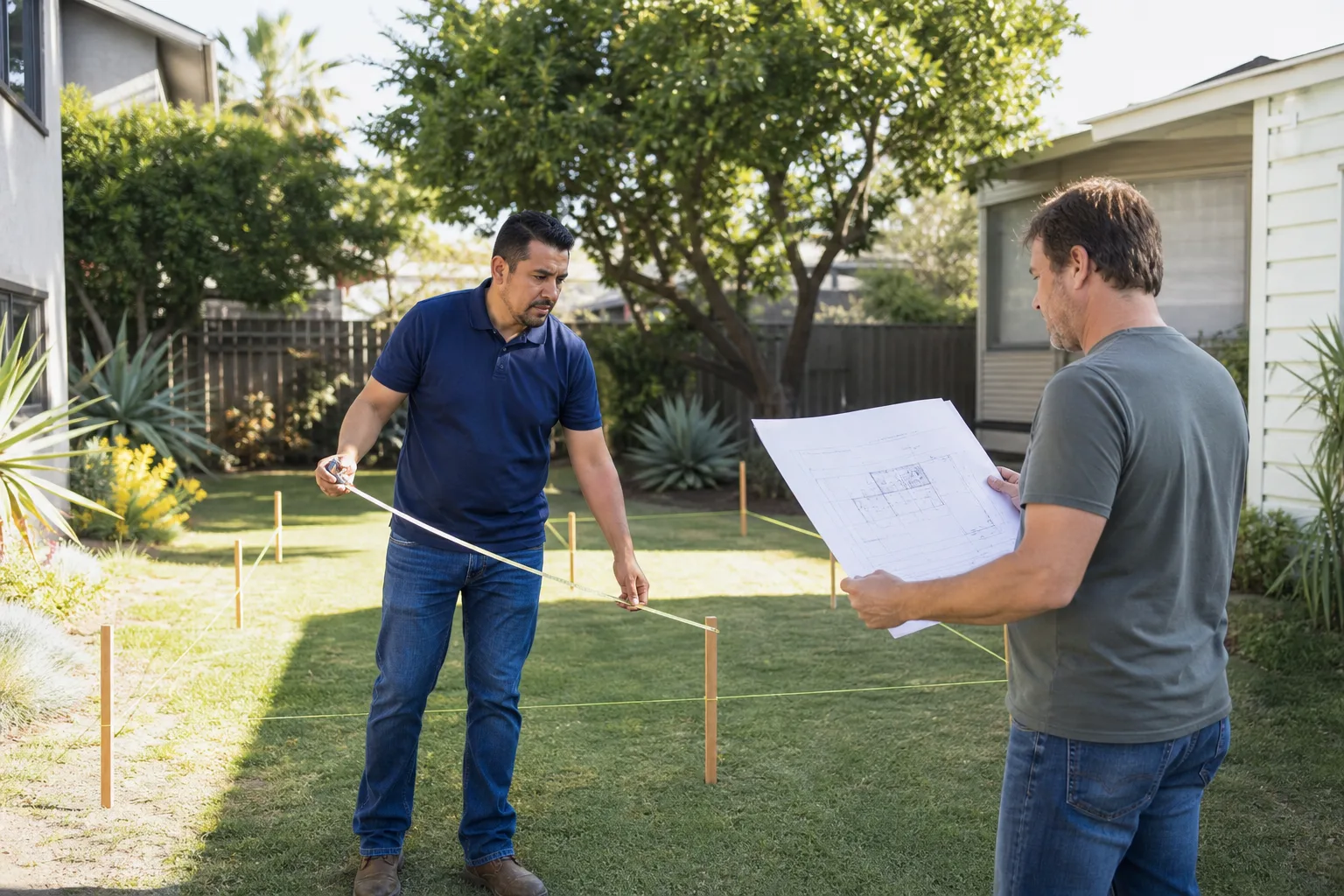
The second is a permit filing confirmation. Dallas requires building permits for ADUs, and the contractor should be able to show you the filed application, the plan review status, and the permit number once it is issued. A contractor who suggests skipping permits to “save time” is inviting the city to red-tag your project and your property value to take the hit.
The third is a project schedule with milestones. Not a vague “six to eight months.” We mean a written schedule showing foundation, framing, mechanical rough-in, drywall, finishes, and final inspection, with dates attached to each phase. Dates shift on real jobsites. A schedule that exists is the thing that lets you hold someone accountable when they do.
The fourth is a written warranty. Ask what it covers, how long it runs, and what happens when something fails. Our standard at Fielding ADU Dallas is The Garrison Standard: every project is backed in writing for a full year. If workmanship fails within 365 days, we return and correct it at no charge. That promise is only worth something if it is on paper. Verbal warranties expire the moment the truck leaves the driveway.
These four documents are not extras. They are the baseline. If a contractor cannot produce all four, move on. You are not being difficult. You are being the person who does not end up in Dallas small claims court explaining why you paid a $40,000 draw for a slab that was never poured.
How to Verify a Texas Contractor License in Eight Minutes
Texas does not license general contractors at the state level the way California does, but it does regulate specific trades, and Dallas itself requires contractors performing certain work to register with the city. The Texas Department of Licensing and Regulation (TDLR) maintains a searchable database of licensed electricians, plumbers, and HVAC technicians. If your ADU involves electrical, plumbing, or mechanical work, which every livable ADU does, those subcontractors should hold current TDLR licenses. You can pull them up at the TDLR website in about eight minutes. Most homeowners in Dallas skip this step entirely. That is a mistake you do not need to make.
Here is the check you should run, in order:
- Confirm the business name. Ask for the legal entity name on the contract, then search it through the Texas Comptroller’s office to verify the business is registered and in good standing.
- Check TDLR for trade licenses. Electrical, plumbing, and HVAC work on an ADU requires licensed tradespeople. Ask for the license numbers and run them.
- Pull complaint history. TDLR posts disciplinary actions. A pattern of complaints about the same company is a signal you cannot ignore.
- Ask about Dallas registration. The City of Dallas requires certain contractors to register. A contractor working in Dallas should be able to tell you their local registration status without blinking.
- Check insurance. Ask for a certificate of insurance naming you as an additional insured. This is standard practice. A contractor who pushes back is not insured the way they should be.
This is not bureaucratic busywork. It is the cheapest insurance you will ever buy. Eight minutes on a government website tells you whether the person in your kitchen quoting a $180,000 backyard ADU in Dallas is licensed, insured, and complaint-free, or whether they are someone who changed a business name after the last job went sideways.
Why Scope Alignment Matters More Than the Bid Itself
Homeowners treat bids as competing numbers. “Contractor A said $142,000, Contractor B said $168,000, so A is cheaper.” That logic is wrong in Dallas ADU work. Bids that do not match scopes are not bids. They are unrelated numbers attached to different projects. One contractor’s $142,000 may include site prep, foundation, electrical service upgrade, insulation at code, and a finished interior with drywall, paint, and flooring. Another’s $168,000 may include window upgrades, a mini-split HVAC system, and a Dvele panelized shell that arrives in three weeks. The price difference tells you nothing until you line up the scopes side by side.
Before you compare any numbers, create a single written scope of work and give the identical document to every contractor you are considering. It should list the square footage, the number of rooms, the ceiling height, the exterior finish (we commonly use James Hardie siding on conventional Dallas builds), the electrical panel capacity, the HVAC approach, the insulation standard, the foundation type, and the site access conditions. When every contractor prices the same thing, the numbers finally mean something.
Then look at what each contractor added or subtracted. Did one leave out the sewer connection? Did one skip the plan review fee? Did one price a Tuff Shed-style shell while the other priced a fully finished ADU with a bathroom and kitchen? These differences are not noise. They are exactly where change orders are born. A contractor who quotes low by omitting the site utility trench will “discover” that cost two weeks in and hand you a change order for $8,000. The scope you align before the bid is the scope that protects you after it.
This is also where a written-price-first policy matters. At Fielding ADU Dallas we put the price in writing before any work starts, and that price is tied to a scope we prepared together. If the scope changes because you change it, the price changes and we talk about it first. If the scope does not change, the price does not move. That is the entire system. It is not complicated. It is just rare.
Interview Questions That Reveal How a Contractor Handles Problems
Every contractor sounds competent in a sales meeting. The meeting is designed to be a clean, optimistic hour. The question is not how they sell the job. The question is how they run it when the slab hits rock, the city plan checker asks for revisions, or the prefab panel shipment arrives warped. Those moments happen on Dallas ADU jobs. The contractor’s answer reveals whether you are hiring a builder or a problem-deferrer. Ask these questions in the interview, and listen more than you talk.
- “Walk me through what happens when the city issues corrections on the plans.” A real answer names the process: who responds to the plan reviewer, how fast, and who pays for the revision time. A weak answer waves it off: “we handle all that.”
- “What change orders have you issued in the last year, and why?” Every contractor issues change orders. The honest ones can name real examples and explain what drove them. A contractor who says they never have change orders is either lying or underbidding scopes on purpose.
- “Who is on my jobsite every day, and are they background-checked?” You should be able to know exactly who is on your property. At Fielding ADU Dallas, every crew member is background-checked and arrives in uniform. You should never wonder whether the person at your back door is authorized to be there.
- “If I see something that looks wrong mid-project, what is the process for raising it?” The contractor should point to a specific person and a specific channel: “Text the project manager; he responds within a day.” A vague “just call me anytime” means no process exists.
- “What does your warranty actually cover, and can I see it in writing before I sign?” If they cannot hand you the warranty document with the contract, you do not have a warranty. The Garrison Standard at Fielding ADU Dallas is written on paper before work starts: one full year, workmanship defects corrected at no charge, free second visit if something fails. If a contractor will not put warranty terms in writing, walk.
Notice what these questions do. They move the conversation from the sales pitch to the jobsite. A contractor who handles problems well is the contractor you want running your Dallas ADU project. A contractor who gets defensive at the question is showing you the future.
Why the Lowest Bid Is Usually the Most Expensive Outcome
The lowest bid in Dallas ADU work is not the cheapest option. It is the most expensive outcome wearing a discount costume. The math is consistent, and once you see it, the conversation with a spouse who wants to save $20,000 becomes a lot easier. Low bids do not come from better efficiency. They come from three places, and all three cost you later.
The first is omitted scope. The low bid leaves out the sewer line, the electrical panel upgrade, the foundation engineering, or the insulation. Those items are not optional in Dallas. They are code-required. The contractor knows this. The low bid is the hook. The change orders are the business model.
The second is cheap labor. An unlicensed crew working for cash, no background checks, no training. They may frame the walls wrong and disappear when the inspector fails the rough-in. You then pay a real contractor to tear out and redo the work. The “savings” became a double payment.
The third is corner-cutting on materials and methods. Cheaper sheathing, skipped flashing, undersized HVAC, no expansion joints in the hardscape. In Dallas the summer heat punishes every shortcut. A poorly insulated ADU in August runs the AC nonstop and still does not hold 78 degrees. The energy bill is a permanent tax on the cheap bid.
Here is how to explain it to a spouse who wants the low number: a $160,000 ADU that finishes on schedule with a written warranty costs $160,000. A $130,000 ADU that hits $185,000 by the end through change orders, plus four months of delays, plus a repair bill two years later, costs considerably more than $160,000. The lower bid was never lower. It was deferred. That is the entire argument, and it is true more often in Dallas than not.
Matching the Right Build Method to Your Dallas Lot
Dallas lots vary enormously: flat suburban parcels in Lake Highlands, tight urban lots in Oak Cliff, long narrow strips in East Dallas, oversized acreage out past Mesquite. The right build method depends on the lot, the budget, and how fast you need the space. We work across the major platforms homeowners are already researching: Abodu, Cover, Dvele, Mighty Buildings, Boxabl, and Plant Prefab. We also build conventional stick-frame ADUs with James Hardie siding and Tuff Shed-style structures for simpler storage-to-living conversions. Fluency across these methods matters because most Dallas contractors only know one way to build. A contractor who only does conventional framing will not tell you when a prefab panelized system is faster and cheaper. A prefab vendor will not tell you when site constraints make conventional framing the better call. You want a contractor who builds both ways and can explain the trade-offs honestly.
Prefab and modular systems like Dvele and Plant Prefab fit best on lots where access is straightforward and the timeline matters. The modules arrive on a truck, the crane sets them, and the interior finish happens in a factory while the Dallas foundation cures. This compresses the schedule significantly versus conventional framing, which builds everything on site. The trade-off is lot access: a narrow Duncanville side yard with overhead power lines may not accommodate a crane or a modular delivery. On those lots, conventional framing or a panelized kit is the realistic choice.
Dallas soil also shapes the foundation decision. Expansive clay soil moves with moisture levels, and an ADU foundation needs to be engineered for that movement. A contractor who has built in Dallas for years knows what the local soil does. One who just moved here from a coastal market may not. Ask how the foundation design accounts for local soil conditions. If the answer is a blank stare, that is an answer too.
Dallas Permit Process: What Should Actually Happen
The Dallas building permit process is not a mystery, but it is a sequence, and skipping any step creates problems later. A legitimate ADU contractor in Dallas files the plans with the city, responds to plan review comments, pulls the permit, schedules inspections at the right milestones, and keeps the permit board visible on the jobsite. If you never see a permit board, the work is unpermitted, and you are the one who pays for that when the city finds out or when you try to sell the house.
Dallas requires the following for a standard ADU project:
- A site plan showing the ADU location, setbacks from property lines, and existing structures.
- Engineered foundation and structural drawings prepared for Dallas soil conditions and wind loads.
- Electrical, plumbing, and mechanical plans, including the panel upgrade if the main service cannot carry the additional load.
- Energy code compliance documentation, typically via REScheck or an equivalent.
- Inspections at each phase: footing, foundation, framing, rough-in, insulation, drywall, final.
The contractor should be able to show you every one of these documents and walk you through the inspection schedule. “We’ll pull the permit” is not enough. At Fielding ADU Dallas, permitted work done by the book is part of The Garrison Code: Show up in the window, price in writing, by the book, leave it clean, stand behind it for a year. The permit is not a formality. It is the document that proves the work was done to the code Dallas requires.
Realistic Timelines for ADU Construction in Dallas
An ADU in Dallas takes longer than most homeowners expect and less time than the worst horror stories suggest. For guidance on keeping yours on track, see our Seasonal ADU Care for Dallas: Year-Round Homeowner’s Guide. The honest timeline for a conventional 600-to-800-square-foot ADU from contract signing to final inspection runs roughly five to eight months. Prefab and modular builds with systems like Abodu or Mighty Buildings can compress this to three to five months from permit approval, assuming the lot access works for delivery. Garage conversions inside an existing structure often run four to six months. These are real numbers, not sales-brochure numbers.
The timeline breaks down into phases that matter:
- Design and plans: 3-6 weeks. Site survey, floor plan, structural engineering, energy calcs.
- Plan review and permitting: 4-10 weeks. This is the phase homeowners underestimate most. The city’s review queue moves at the city’s pace.
- Site work and foundation: 2-4 weeks. Demolition if converting, excavation, formwork, pour, cure.
- Framing and shell: 2-4 weeks. Walls, roof, windows, exterior siding, weatherproofing.
- Mechanical and rough-in: 2-4 weeks. Electrical, plumbing, HVAC rough-in, plus the rough inspection.
- Insulation and drywall: 1-3 weeks. Then the insulation inspection.
- Finishes: 3-6 weeks. Flooring, cabinetry, paint, fixtures, trim.
- Final inspection and punch list: 1-2 weeks. City sign-off, walkthrough, corrections, closeout.
Weather shifts these numbers. Dallas spring storms can delay a foundation pour. Summer heat slows exterior work. A contractor who promises a guaranteed date is guessing. A contractor who gives you a milestone schedule and updates it when reality moves is running the job properly. Ask for the schedule in writing before you sign, and ask how they handle slippage. The answer should be specific.
Common Mistakes to Avoid
- Signing a contract without a written fixed price. If the number is not on paper, the number does not exist. Verbal estimates become $30,000 surprises in month three, and you have no leverage to dispute them.
- Skipping the TDLR and Dallas registration check. Eight minutes of searching spares you from hiring a contractor with open complaints or canceling licenses. Almost nobody in Dallas does this check, and it shows in the outcomes.
- Comparing bids without aligning scopes first. A $142,000 bid and a $168,000 bid for different scopes compare nothing. Line up the scope line by line before you look at totals.
- Accepting a verbal warranty. “I stand behind my work” means nothing in Dallas heat two summers later. Get the warranty on paper: coverage, duration, and the process for making a claim.
- Letting the contractor talk you out of permits. Unpermitted ADUs in Dallas create problems on resale, on refinancing, and on insurance claims. The contractor who skips permits saves himself time. He costs you everything else.
- Choosing the lowest bid as a default. The low bid in Dallas ADU work is the most expensive outcome by another name. Omitted scope, cheap labor, and corner-cutting all bill you later at premium rates.
- Not asking who is on the jobsite. Background-checked, uniformed crews are a baseline standard. If the contractor cannot tell you who will be at your back door on a Tuesday, assume the worst.
When to Call a Professional
ADU construction is not a project to manage solo. The moment you are serious about adding living space in Dallas, whether it is a backyard unit, a garage conversion, or a room addition, the right move is to bring in a contractor early. If you have a lot with possible setback issues, an older home with an undersized electrical panel, or a city plan review that kicked back corrections, those are specific signals that you need someone who has navigated Dallas permitting before. Fielding ADU Dallas offers free estimates across Dallas and the surrounding areas. Our team has built ADUs, garage conversions, and room additions throughout the metro since 2006, always under The Garrison Standard: written price before work starts, permitted work done by the book, and a full-year written guarantee. Call (903) 342-8977 to schedule your free estimate.
Frequently Asked Questions
A finished ADU in Dallas typically runs $180,000 to $350,000 for a 600-to-800-square-foot unit with a kitchen and bathroom, depending on the build method, site conditions, and finish level. For a deeper look at pricing, see our ADU Cost Breakdown: The Dallas Homeowner’s Reference for 2026. Prefab systems like Dvele or Abodu often land in the $200,000 to $320,000 range including site work and installation. A simpler garage conversion can run $80,000 to $150,000 before permit fees. Call (903) 342-8977 for an exact quote on your lot; estimates are free.
A conventional ADU in Dallas takes five to eight months from contract to final inspection, with permitting typically consuming four to ten weeks of that timeline. Prefab and modular builds can finish in three to five months when lot access works for delivery. Garage conversions often run four to six months. The city’s plan review queue drives much of the variance, which is why a written milestone schedule matters more than a promised end date.
Yes. Dallas requires building permits for ADUs, including site plan approval, engineered drawings, and phased inspections from footing through final. Unpermitted work creates problems on resale, refinancing, and insurance claims. A legitimate ADU contractor files the permit, manages plan review corrections, and keeps the permit board posted on the jobsite.
It depends on your lot and your timeline. Prefab and modular systems like Plant Prefab, Mighty Buildings, and Boxabl work well on lots with clear crane or truck access and compressed schedules. Conventional framing fits tight lots, narrow side yards, and sites where a modular delivery cannot reach. Dallas soil conditions affect the foundation either way, so work with a contractor who understands local expansive clay behavior. Fielding ADU Dallas builds both ways and can help you choose the right method for your property.
Ask for the warranty in writing before you sign, and confirm three things: what it covers, how long it runs, and what happens when something fails. The Garrison Standard at Fielding ADU Dallas covers workmanship defects for 365 days, and if something fails inside that year, we return at no charge and correct it. A contractor who will not put warranty terms on paper is not offering a warranty; they are offering a goodbye.
Not if the scope does not change and the price was fixed in writing before work began. Legitimate price changes come from a client-changed scope, a plan reviewer requirement, or an unforeseen site condition discovered after excavation. They should always be documented as a written change order before the work proceeds. A contractor who runs up the price without a written change order is not managing a project; he is managing your bank account.
The Bottom Line
Hiring an ADU contractor in Dallas is not about collecting three bids and hoping. For more guides & resources, explore our blog. It is about demanding the four documents a serious contractor produces without being asked, verifying the license and complaint history through TDLR, aligning scopes before comparing prices, and asking interview questions that reveal how problems get handled mid-job. The lowest bid is usually the most expensive outcome, and the warranty is only real if it is in writing. Fielding ADU Dallas has been building to The Garrison Standard since 2006: written price before work starts, permitted work done by the book, a one-year written guarantee, and background-checked crews. If you are ready to talk about your ADU, call (903) 342-8977 for a free estimate.
Written by Reed Calloway, Owner at Fielding ADU Dallas, serving Dallas since 2006.